
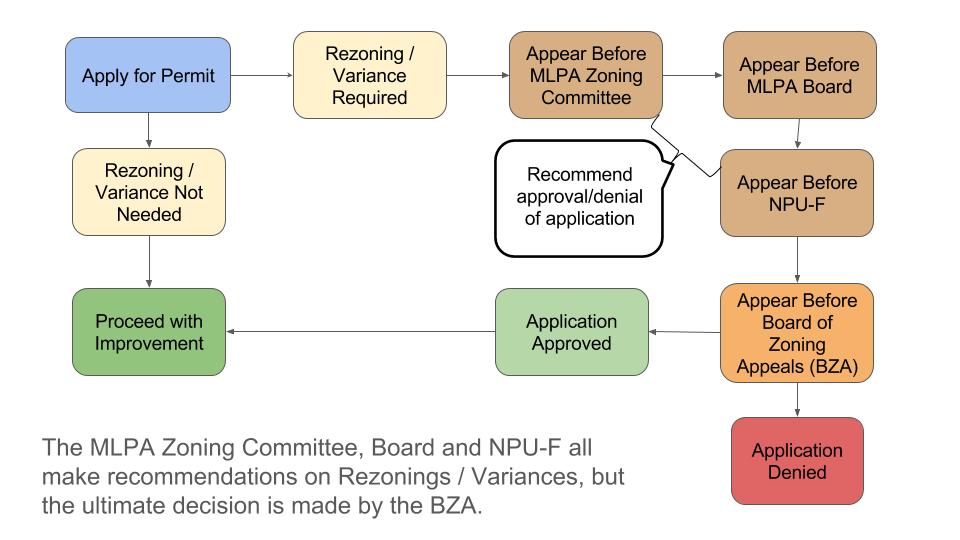
Variance Request Process in Morningside Lenox Park
What is a Variance Request?
A Variance Request is a formal request to get permission to break one or more specific zoning rules because following them would cause a hardship for your property.
Every property in Atlanta has zoning rules, things like:
- How close a house can be to the street (setbacks)
- How tall a building can be
- How much of the lot you can cover
- Parking requirements
- Minimum lot size
If a property owner can’t reasonably comply with one of those rules because of something unique about their property (like an oddly shaped lot, steep slope, or unusual topography), they can ask the city for a variance.
It is not:
- A way to change the zoning category (that’s a rezoning).
- A way to ignore rules just for convenience.
- A guarantee of approval.
In Atlanta, the owner must typically show:
- There’s a special condition unique to the property
- The hardship wasn’t self-created
- Granting the variance won’t harm the public interest
- It’s the minimum relief necessary
A simple example:
If zoning requires a 35-foot front setback but the lot is unusually shallow, the owner might request a variance to build 25 feet from the street instead.
The Variance Request Application
Applying for a Variance
If you are working with a contractor, architect, or landscape professional, they should understand zoning requirements and advise whether a variance is necessary. Many professionals work with a variance expeditor who can file the application for a fee. If not, you may complete the process yourself.
How do you apply for a Variance?
The first thing you will need to do is to go online and download the Application For Board Of Zoning Adjustment Variances & Special Exceptions.
Application for Variance & Special Exceptions
The application has a checklist for all that you will need. Do not fail to include anything that is required as doing so will cause the application to be returned.
Once you have completed the application and have all the required documents, you are ready to file the application. All applications must be filed online through the Accela Portal.
- Create an account
- Select “Create New”
- Choose “Planning or Historic Preservation Application”
- Follow the prompts and submit all required documentation
The City will review your submission and notify you if additional information is required. Once complete, the application is forwarded to the applicable Neighborhood Planning Unit.
For Morningside Lenox Park, this is Neighborhood Planning Unit F. NPU-F notifies the Morningside Lenox Park Association and its Zoning Committee. A committee representative will contact you to discuss next steps and schedule a site visit.
Meetings and Neighbor Notification
You will be required to attend four meetings to discuss your Variance Request Application:
- MLPA Zoning – First Tuesday of each month, 7:00 p.m. (Zoom). Zoom link available at www.mlpa.org via the View Calendar button.
- MLPA Board Meeting – Second Monday of each month, 7:00 p.m. (Zoom). Zoom link available at www.mlpa.org via the View Calendar button.
- NPU F – Third Wednesday of each month, 7:00 p.m. (Zoom). Zoom link available at www.mlpa.org via the View Calendar button.
- Board of Zoning Adjustment (BZA) – Date and Time will be assigned. City Council Chamber, 55 Trinity Avenue, Atlanta.
The Board of Zoning Adjustment conducts the final hearing and renders the final decision.
Neighbors may attend meetings to ask questions, express support, or oppose the request. Because a variance may affect neighboring properties, applicants are expected to notify adjacent property owners and, where appropriate, those with visibility of the proposed project.
It is required that applicants speak with affected neighbors before filing. Written confirmation of notification should reference the specific variance request and will be required by the MLPA Zoning Committee.
The Zoning Committee may recommend support, not support, support with conditions, or deferral for additional information. That recommendation is forwarded to the MLPA Board, and the process continues through each required body, culminating with the Board of Zoning Adjustment’s final decision.
